
Autism Meltdown vs Tantrum: How to Tell the Difference and What to Do

Your child is screaming on the kitchen floor, and you have about three seconds to decide how to respond. Is this a tantrum you should calmly ride out, or a meltdown that needs a completely different approach? Getting the autism meltdown vs tantrum question right changes everything about what you do next.
The two can look almost the same from the outside. Both can involve crying, yelling and throwing things. The cause is different, though, and so is the right response. This autism meltdown vs tantrum guide shows you how to tell them apart, what to do in each case and how to get every adult in your home responding the same way.
What Is the Difference Between an Autism Meltdown vs Tantrum?
The main difference is control. A tantrum is driven by anger or frustration, often over something the child wants, and the child keeps some control. It usually fades if ignored. A meltdown is an involuntary response to feeling overwhelmed by sensory input, stress or change. It can last much longer and needs calm support, not consequences.
The Child Mind Institute in New York explains that a child having a tantrum knows what they are doing.1 A meltdown, by contrast, can seem to come out of nowhere. It may include hitting, head banging or damaging property, and it can last from minutes to several hours.1
The National Autistic Society describes a meltdown as an intense response to an overwhelming situation, in which a person temporarily loses control of their behavior.2 It stresses that a meltdown is not bad behavior.2 Autistic children can still have ordinary tantrums, too. The goal is to read which one you are seeing.
Why Does the Difference Matter?
Getting the autism meltdown vs tantrum call wrong has a cost: tantrum strategies can make a meltdown worse. Ignoring a child who is overwhelmed, or adding a consequence in the middle of it, piles on more stress. Talking a lot or arguing can push your child further toward a crisis.1
Meltdowns are also hard on the child. They are not a choice, and children often seem tired or confused as one winds down.1
Related Study: A 2023 study in the journal Autism asked 32 autistic adults what a meltdown feels like from the inside. Most described feeling overwhelmed by information, by their senses and by social and emotional stress.3
How Can You Tell Which One Is Happening?
When the autism meltdown vs tantrum question comes up, ask yourself a few quick questions. No single answer settles it, but together they point you in the right direction.
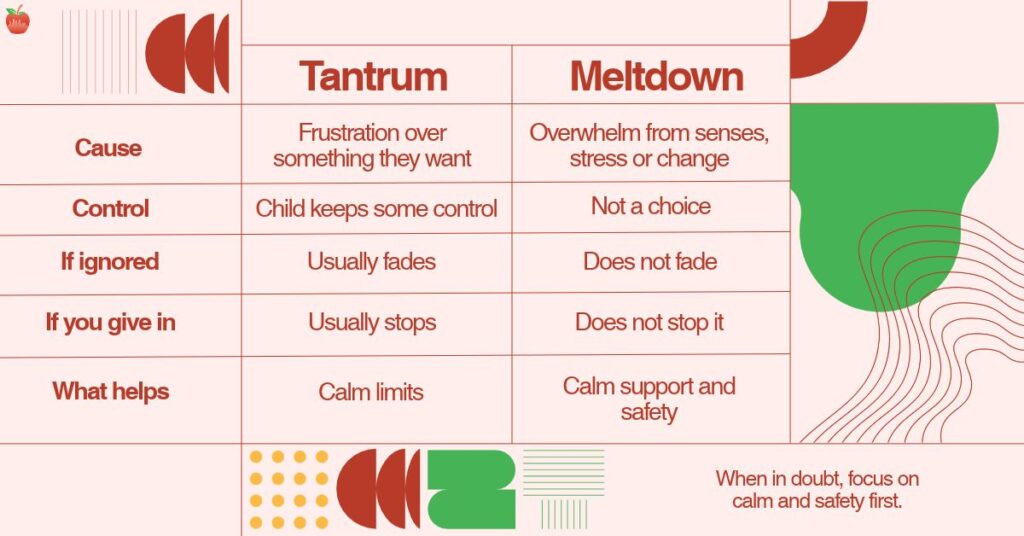
Five Quick Questions: Autism Meltdown vs Tantrum
- Did it start after you said “no” or took something away? That points toward a tantrum.
- Did it start after noise, crowds, a sudden change or a long, demanding day? That points toward a meltdown.
- Does it ease when it gets no reaction? A tantrum usually fades when ignored.1 A meltdown does not.
- Would giving in stop it right away? If yes, it is likely a tantrum. A meltdown needs calm support to end, from you or from your child’s own coping skills.1
- Can your child still respond to you? At the peak of a meltdown, a child may stop responding to calming attempts.1
If the autism meltdown vs tantrum answer is unclear, focus on calm and safety first. You can sort out the cause later.
What Are the Warning Signs Before a Meltdown?
Warning signs before a meltdown include pacing, rocking, fidgeting, tapping hands, asking the same question again and again, or becoming very still and staring into space. This early stage is often your very best chance to prevent a full meltdown. Remove the trigger, lower noise and light, or offer a favorite calming activity right away.
The National Autistic Society calls this the “rumble stage.”2 The Child Mind Institute describes the same stage as agitation.1 At this point, avoid trying to solve the problem through long discussion, since it can backfire.1 Short, simple choices work better.
What Should You Do During a Meltdown?
During a meltdown, stay calm and say very little. Focus on safety. Move your child away from hard surfaces or sharp objects, and move other children out of the room. Dim the lights and cut the noise if you can. Give your child space, wait at least a minute between prompts, and do not argue or reason.
Child Mind Institute experts suggest keeping words short and concrete as things escalate.1 A laminated card with a few calming choices, such as headphones, deep breaths or coloring, can help your child point instead of talk.1 Once a meltdown peaks, your job is no longer to stop it. Your job is to keep everyone safe until it passes.1
Do not stand too close if your child is hitting or kicking, since you could be hurt.1 If your child is banging their head, guide them to a softer surface, such as a bed.1
When to Call for Emergency Help
If a crisis goes on for a long time and you cannot keep your child or others safe, call 911.1 The Child Mind Institute also suggests letting local police or EMTs know ahead of time that an autistic child lives in your home.1 If your child talks about wanting to hurt or kill themselves, call or text 988, the Suicide and Crisis Lifeline, or call 911 if they are in immediate danger.4
How Should You Respond to a Tantrum?
A tantrum calls for calm limits. Stay nearby, keep your voice even and do not give in to the demand that started it. When a tantrum gets no reaction, it usually fades quickly.1
Once your child is calm, praise them for using words or other ways to show what they want. Over time, they learn that asking works better than screaming.
What Helps After a Meltdown?
Recovery takes time. Your child may seem confused, tired or disoriented as the intensity drops.1 Give them quiet, water and comfort. Avoid pushing them to talk about what happened too soon, since that can restart the crisis.1
Later, when everyone is calm, think through what set it off. Talk with siblings separately, too. Watching a meltdown can be stressful for them.1
How Can You Prevent Meltdowns at Home?
To prevent meltdowns, learn your child’s triggers by writing down what happened before, during and after each one. Use a visual schedule so the day feels predictable. Preview changes a few days ahead. Build in quiet time after school, and keep headphones or other calming tools close. Small changes to noise and light help, too.
The National Autistic Society recommends keeping a diary of each meltdown to spot patterns in time, place or events.2 Common triggers include sudden schedule changes, loud noise, social confusion and not enough time for favorite interests.1
Many children hold it together at school and melt down at home, where they feel safe.1 An hour of quiet time after school, with a snack and no demands, can make the evening easier.1
How Do You Handle a Meltdown in Public?
City life comes with crowds, sirens and packed trains. Plan ahead for outings. Bring a small kit with headphones, a favorite object and a snack.1 Know where you can step away, such as a quiet corner of a store or the next stop off the train.
If a meltdown starts in public, ask people to give space and not stare.2 Turn your attention to your child, not to onlookers. You do not owe strangers an explanation.
How Can Every Caregiver Respond the Same Way?
Grandparents, sitters and aides often step in when meltdowns happen. Write a one-page calm plan so everyone reacts the same way. It should cover both sides of the autism meltdown vs tantrum question. Include:
- Your child’s known triggers.
- Early warning signs to watch for.
- The exact calming choices that work, such as headphones or a quiet corner.
- What to say and what not to say.
- How to keep your child and others safe.
- Who to call and when to call 911.
Keep the plan short enough to read in a minute. Post it where any caregiver can find it, and update it as you learn more.
How Does City Choice Home Care Support Families?
City Choice Home Care has been a licensed New York home care provider since 2005. Our pediatric aides help children with bathing, dressing, toileting, meals and daily routines at home. They follow your child’s established routines and the calm plan your family has built.
Every caregiver is background-checked, bonded, insured and trained through a program approved by the New York State Department of Health. We hire only about 1 in 25 applicants. When we match an aide with your family, we consider your child’s needs, language, culture and personality.
City Choice Home Care is also an OPWDD-approved provider. Families whose child already receives OPWDD services can add home care alongside them. There are no long-term contracts, and you are never locked in.
We serve families across Manhattan, Brooklyn, Queens, The Bronx, Staten Island and Westchester, with a 24/7 intake line. Contact us to talk about your child’s needs.
Related Guides
- Pediatric Home Care in New York City
- Pediatric Care Services
- Home Care in New York: A Complete Guide
- Service Areas
- Why City Choice
Sources
- Wilkins F, Black CJ. How to de-escalate an autistic meltdown. Child Mind Institute. Updated July 15, 2026. Accessed November 10, 2026. https://childmind.org/article/how-to-de-escalate-an-autistic-meltdown/
- National Autistic Society. Meltdowns: a guide for all audiences. Accessed November 10, 2026. https://www.autism.org.uk/advice-and-guidance/behaviour/meltdowns/all-audiences
- Lewis LF, Stevens K. The lived experience of meltdowns for autistic adults. Autism. 2023;27(6):1817-1825. doi:10.1177/13623613221145783
- 988 Suicide & Crisis Lifeline. Get help now. Accessed November 27, 2026. https://988lifeline.org/