
Bathroom Safety for Seniors: A Practical Guide for New York Apartments
The bathroom is small, wet and full of hard surfaces. For an older adult with weaker legs or slower balance, it is one of the riskiest rooms in the home. Good bathroom safety for seniors comes down to a few well-placed changes. Most cost little and take an afternoon.
This guide to bathroom safety for seniors shows where injuries happen and which fixes matter most. It also covers what renters can do when drilling into tile is not an option. That last point matters in New York City, where many older adults rent and share building hot water systems.
Why Is the Bathroom So Risky for Older Adults?
The bathroom is risky for older adults because wet, slippery floors and hard surfaces combine with tasks that test balance, like stepping out of a tub or standing up from a toilet. Weaker muscles, slower reflexes and nighttime trips add to the danger. Most bathroom injuries come from falls, and injury rates rise sharply with age.
A Centers for Disease Control and Prevention (CDC) study found that falls caused about 81% of bathroom injuries treated in emergency departments.2 Injury rates climbed steadily with age.2 Fractures also became much more common in older age groups.2
Related Study: In a CDC report in Morbidity and Mortality Weekly Report, the tub or shower had the highest injury rate. The toilet came second. Getting out of the tub or shower caused far more injuries than getting in.2
Which Part of the Bathroom Is Most Dangerous?
Most families focus on the shower, and that makes sense. Bathing, slipping and getting out of the tub are common causes of injury.2 The toilet, though, deserves just as much attention as your parent ages.
In the CDC study, injuries on or near the toilet rose from 4.1 per 100,000 people aged 15 to 24 to 266.6 per 100,000 among those 85 and older.2 Among people 85 and older, more than half of bathroom injuries involved the toilet.2 Sitting down and standing up takes leg strength and balance, both of which decline with age.
What Are the Basics of Bathroom Safety for Seniors?
The easiest bathroom safety fixes for seniors cost little or nothing. Remove loose rugs or use rubber-backed ones. Put a non-slip mat or strips in the tub or shower. Wipe up water right away. Keep the path to the bathroom clear. Add a nightlight. Move toiletries within easy reach so no one has to bend or stretch.
Start with this quick list:
- Clear the doorway and hallway of clutter and throw rugs.3
- Use rubber-backed rugs, or secure rugs with strips that cover the whole back.3
- Add a non-slip rubber mat or self-stick strips to the tub or shower floor.1
- Wipe up spills and standing water right away.3
- Keep everyday items within easy reach, using a shower caddy if needed.3
- Leave space for a walker or wheelchair if your parent uses one.3
Watch the small raised strip at the bathroom door, sometimes called a saddle. Many older city apartments have one. VNS Health notes that a physical or occupational therapist can teach a safer way to step over it.3
Where Should Grab Bars Go?
Grab bars should go inside the tub or shower, just outside it where your parent steps out, and next to the toilet. Have a professional install them into studs or proper anchors at the right height and angle. Never use a towel bar as a grab bar, because towel bars are not built to hold a person’s weight.
Both the CDC and VNS Health recommend grab bars inside and outside the tub or shower and near the toilet.1,2,3 A physical therapist can help decide the best height and placement for your parent.3
What If You Rent or Cannot Drill Into Tile?
Many New Yorkers rent, and landlords may limit changes to walls and tile. Ask your landlord or building manager first. If drilling is not possible, VNS Health suggests a U-shaped grab bar that fits over the side of the tub.3 It clamps in place without holes.
Whatever you choose, never lean on a towel bar. It is held up by glue or grout and cannot safely carry a person’s weight.3
What Equipment Helps in the Shower and at the Toilet?
A few pieces of equipment make the riskiest tasks easier:3
- A shower chair or bench, so your parent can sit while washing.
- A handheld shower head, which lets them rinse while seated.
- A raised toilet seat, with or without handles, to make standing up easier.
- A help button or medical alert necklace, in case of a fall.
An occupational therapist can recommend and order the right equipment for your parent’s needs.3 Therapists can also act as a neutral voice if family members disagree about what is necessary.3
How Hot Should Bath Water Be?
Bath and shower water for seniors should be no hotter than 120 degrees Fahrenheit. The U.S. Consumer Product Safety Commission recommends setting water heaters at that level. Older skin burns faster, and slower reactions make it harder to pull away. Test the tap with a cooking thermometer, and adjust the water heater if it reads too hot.
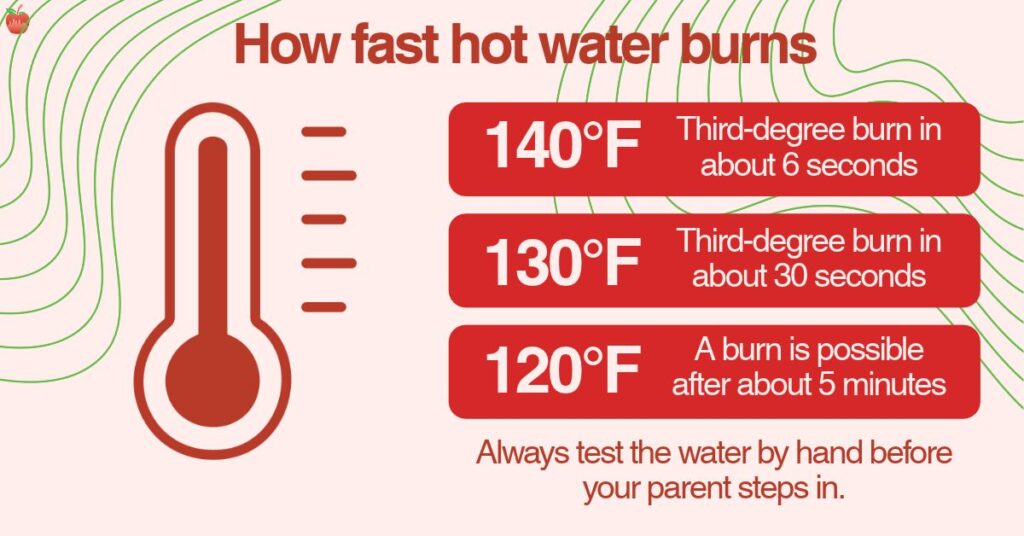
Hotter water burns quickly. Most adults suffer third-degree burns in about 6 seconds at 140 degrees and about 30 seconds at 130 degrees.4 Even at 120 degrees, a burn is possible after about five minutes.4
Many New York apartments get hot water from a central building system. In that case, you cannot change the setting yourself. The Consumer Product Safety Commission advises contacting your building manager to discuss options.4 Until the building adjusts it, always test the water by hand before your parent steps in.4
How Do You Make Nighttime Bathroom Trips Safer?
Nighttime trips are a hidden risk to bathroom safety for seniors. Light the path from bed to toilet. The CDC recommends a nightlight between the bedroom and bathroom, and some turn on automatically after dark.1
If there is no outlet nearby, battery-powered push lights work well.3 Keep a lamp within reach of the bed, so your parent never walks in the dark.1
What Should You Do If Your Parent Falls in the Bathroom?
If your parent is hurt, hits their head or cannot get up, call 911. Do not try to lift them on your own if they seem injured.
Even a fall without obvious injury is worth reporting to their doctor. Their doctor can look for causes such as balance problems or medicine side effects. A help button or medical alert device means your parent can call for help even if no one else is home.3
When Is It Time to Get Help With Bathing?
Sometimes bathroom safety for seniors takes more than equipment. Signs include skipping showers, wearing the same clothes for days or avoiding the tub out of fear. Bathing is private, so many people resist help at first. A trained aide who treats your parent with dignity can make bathing safe again.
How Does City Choice Home Care Support Bathroom Safety for Seniors?
City Choice Home Care has been a licensed New York home care provider since 2005. Our home health aides and personal care aides help older adults with bathing, toileting, dressing and moving safely around the home. They give a steady hand at the moments the CDC flags as riskiest, such as getting out of the tub and standing up from the toilet.
Every caregiver is background-checked, bonded, insured and trained through a program approved by the New York State Department of Health. We hire only about 1 in 25 applicants. When we match an aide with your parent, we consider their care needs, language, culture and personality.
There are no long-term contracts. We serve families across Manhattan, Brooklyn, Queens, The Bronx, Staten Island and Westchester, and our intake line is open 24/7. Contact us to talk about help at home.
Related Guides
- Home Care in New York: A Complete Guide
- Home Care Services
- Service Areas
- Why City Choice
- Pediatric Home Care in New York City
Sources
- Centers for Disease Control and Prevention. Check for safety: a home fall prevention checklist for older adults. STEADI. 2017. Accessed November 26, 2026. https://stacks.cdc.gov/view/cdc/59197
- Stevens JA, Haas EN, Haileyesus T. Nonfatal bathroom injuries among persons aged ≥15 years: United States, 2008. MMWR Morb Mortal Wkly Rep. 2011;60(22):729-733. Accessed November 10, 2026. https://www.cdc.gov/mmwr/preview/mmwrhtml/mm6022a1.htm
- VNS Health. Bathroom safety for seniors. Updated August 29, 2025. Accessed November 10, 2026. https://www.vnshealth.org/patient-family-support/health-library/bathroom-safety-for-seniors/
- U.S. Consumer Product Safety Commission. Avoiding tap water scalds. Document 5098. Accessed November 10, 2026. https://www.cpsc.gov/s3fs-public/5098-Tap-Water-Scalds.pdf