
Caregiver Burnout: Signs, Causes and Real Relief for New York Families
You love the person you care for. Yet you have not slept through the night in months, you snap at people you love, and your own doctor visits keep getting pushed back. If that sounds familiar, you may be dealing with caregiver burnout. It is common, it is not a personal failure, and there are real ways to ease it.
This guide covers the warning signs and why burnout happens. It also lays out the relief options New York caregivers often miss, from paid leave to free respite programs. The advice applies whether you care for an aging parent, a spouse or a child with a disability.
What Is Caregiver Burnout?
Caregiver burnout is physical, emotional and mental exhaustion that builds when the demands of caring for someone outpace your time, energy and support. It often shows up as constant tiredness, irritability, sleep problems and losing interest in things you used to enjoy. Without relief, it can harm your health and your ability to give care.
Burnout rarely arrives all at once. It creeps in through skipped meals, cancelled plans and nights of broken sleep. Many people miss it until they feel completely empty.
How Common Is Caregiver Burnout?
Very common. About 63 million Americans, nearly one in four adults, provided ongoing care to a family member or friend in the past year.2 That number grew by 20 million between 2015 and 2025.2
Nearly one in four caregivers provides 40 or more hours of care a week, the same as a full-time job.2 One-third have been caregiving for five years or more.2
Related Source: The 2025 Caregiving in the U.S. report from AARP and the National Alliance for Caregiving found that 1 in 5 caregivers reports fair or poor health. Nearly 1 in 4 feels socially isolated, and almost 40% say respite services would help.2
What Are the Signs of Caregiver Burnout?
Common signs of caregiver burnout include feeling overwhelmed or alone, constant tiredness, sleeping too much or too little, weight changes, irritability, frequent sadness or worry, headaches or body aches, and losing interest in hobbies. Some caregivers start making mistakes with medicines or turn to drinking or smoking. Any of these signs deserves attention right away.
The U.S. Office on Women’s Health lists these signs of caregiver stress:1
- Feeling overwhelmed, alone or abandoned by others.
- Sleeping too much or too little.
- Gaining or losing a lot of weight.
- Feeling tired most of the time.
- Losing interest in activities you used to enjoy.
- Becoming easily irritated or angry.
- Feeling worried or sad often.
- Having frequent headaches or body aches.
- Making mistakes when giving medicines.
- Turning to smoking or heavy drinking.
Try a quick weekly check. Pick one evening, read the list and count how many signs fit your past seven days. If the number keeps climbing, treat it as a signal to change something now, not later.
How Does Long-Term Stress Affect Your Health?
Caregiver stress is more than a bad mood. Over time, it can raise your risk of depression and anxiety.1 It can also weaken your immune system, so colds and flu hit harder and healing takes longer.1
Long-term stress can also lead to weight gain, which raises the risk of heart disease and diabetes.1 Some caregivers also notice trouble with short-term memory and focus.1 Your health is part of the care plan. If you go down, the person you care for loses their main support.
Do Parents of Children With Disabilities Burn Out Too?
Yes. Parents raising a child with autism, cerebral palsy or another disability are caregivers, too. Many do it around the clock for years, often while working and raising other children. The same signs and the same relief options apply.
Parents often feel they should be able to handle everything alone. That belief is a fast track to burnout. Asking for help is part of caring well for your child.
How Can You Prevent Caregiver Burnout?
To prevent caregiver burnout, share the work early. Make a list of tasks others can take on and accept offers of help. Join a caregiver support group. Protect your sleep, meals and exercise. Keep your own doctor visits, and tell your doctor you are a caregiver. Schedule regular breaks through respite care before you reach empty.
Make a Help List
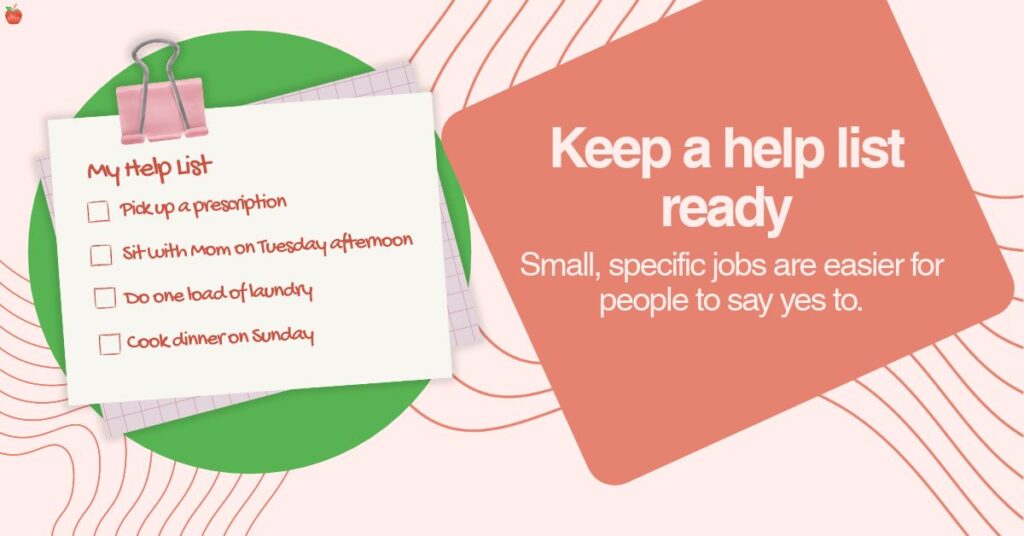
When people say “let me know if you need anything,” most caregivers freeze. Keep a written list ready instead.1 Include small, specific jobs: pick up a prescription, sit with Mom on Tuesday afternoon, do one load of laundry, cook dinner on Sunday. When someone offers, hand them the list and let them choose.
Protect the Basics
Aim to stay active most days, eat healthy food and get enough sleep.1 Keep up with your own checkups, and tell your doctor or nurse that you are a caregiver.1 That one sentence can change the care and advice you get.
Find Your People
A caregiver support group can be a lifeline. You can join a general group or one focused on a specific condition, like dementia or autism.1 Talking with people who understand saves you from explaining everything from scratch.
What Is Respite Care, and How Can It Help?
Respite care is short-term care that gives the main caregiver a break. A trained caregiver can come to your home for a few hours, or your loved one can spend time at an adult day program. Even a few hours a week gives you time to rest, run errands, see a doctor or simply recharge.
The Office on Women’s Health describes respite care as substitute caregiving that gives the primary caregiver a break.1 It can happen at home or at an adult day care center.1 Look into it before you are exhausted. Breaks planned ahead are easier to arrange than breaks needed in a crisis.
Can You Take Paid Time Off to Care for a Family Member in New York?
Often, yes. New York State Paid Family Leave gives eligible employees up to 12 weeks of job-protected, paid time off to care for a family member with a serious health condition.3 You can take it all at once or in full-day pieces.3
In 2026, the benefit is 67% of your average weekly wage, up to a maximum of $1,228.53 a week.3 Covered family members include a spouse or domestic partner, child, parent, parent-in-law, grandparent, grandchild and sibling.3 The family member does not need to live in New York.3 For leave that starts on or after January 1, 2027, the maximum rises to $1,287.91 a week.4
Talk with your human resources office about how to apply. Your loved one’s health care provider will need to complete a certification form, so start early.3
Where Can New York Caregivers Find Free Support?
In New York City, NYC Aging runs a Caregiver Program through community organizations in every borough.5 Services include information and referrals, long-term care planning, support groups, counseling, caregiver training and respite care.5
Call Aging Connect at 212-AGING-NYC (212-244-6469) to find a program near you.5 It is a good first call even if you are not sure what you need yet.
When Should You Get Help Right Away?
Talk with your doctor if signs of caregiver burnout last for weeks or keep getting worse. Feeling hopeless, numb or unable to cope deserves attention, just like a physical symptom.
If you have thoughts of hurting yourself or the person in your care, call or text 988 to reach the Suicide and Crisis Lifeline. For a medical emergency, call 911 or go to the nearest emergency room.1
How Does City Choice Home Care Help Caregivers?
Caregiver burnout often eases once someone else shares the load. City Choice Home Care has been a licensed New York home care provider since 2005. Our home health aides and personal care aides help with bathing, dressing, meals, medication reminders and moving safely around the home. Pediatric aides support children with daily routines, too.
Every caregiver is background-checked, bonded, insured and trained through a program approved by the New York State Department of Health. We hire only about 1 in 25 applicants. When we match an aide with your family, we consider care needs, language, culture and personality.
There are no long-term contracts. We serve families across Manhattan, Brooklyn, Queens, The Bronx, Staten Island and Westchester, and our intake line is open 24/7. If you need a break, contact us to talk through your options.
Related Guides
- Home Care in New York: A Complete Guide
- Pediatric Home Care in New York City
- Home Care Services
- Pediatric Care Services
- Service Areas
Sources
- Office on Women’s Health. Caregiver stress. U.S. Department of Health and Human Services. Updated May 4, 2026. Accessed November 10, 2026. https://www.womenshealth.gov/a-z-topics/caregiver-stress
- AARP, National Alliance for Caregiving. New report reveals crisis point for America’s 63 million family caregivers. Press release. July 24, 2025. Accessed November 10, 2026. https://www.aarp.org/press/releases/2025-07-24-new-report-reveals-crisis-point-for-americas-63-million-family-caregivers.html
- New York State Paid Family Leave. Paid Family Leave for family care; New York Paid Family Leave updates for 2026. Accessed November 10, 2026. https://paidfamilyleave.ny.gov/paid-family-leave-family-care
- HR Morning. New York announces 2027 Paid Family Leave rate and contribution cap. 2026. Accessed November 24, 2026. https://www.hrmorning.com/news/new-york-paid-family-leave-cap/
- NYC Aging. Caregiving. NYC Department for the Aging. Accessed November 10, 2026. https://www.nyc.gov/site/dfta/services/caregiving.page