
Elderly Parent Refuses Help? What to Say, What to Try and When to Step In

The dishes are piling up, Dad missed another doctor’s appointment, and every offer of help gets the same answer: “I’m fine.” If your elderly parent refuses help, you are far from alone. Most of the time, the “no” is not really about the help. It is about fear, pride and holding on to control.
This guide explains why older parents push back and what to say instead of arguing. It also covers small steps that make help easier to accept. Finally, it explains when safety has to come first and which New York City resources can step in.
What Should You Do When an Elderly Parent Refuses Help?
When an elderly parent refuses help, start by finding out why. Listen more than you talk. Focus on one or two concerns, not everything at once. Offer choices so your parent stays in control, and suggest a small trial, like a few hours a week. Step in quickly only if safety is at risk.
Pushing harder rarely works. A parent who feels cornered usually digs in. But a parent who feels heard is more likely to say yes, even if it takes a few conversations.
Why Do Older Parents Say No?
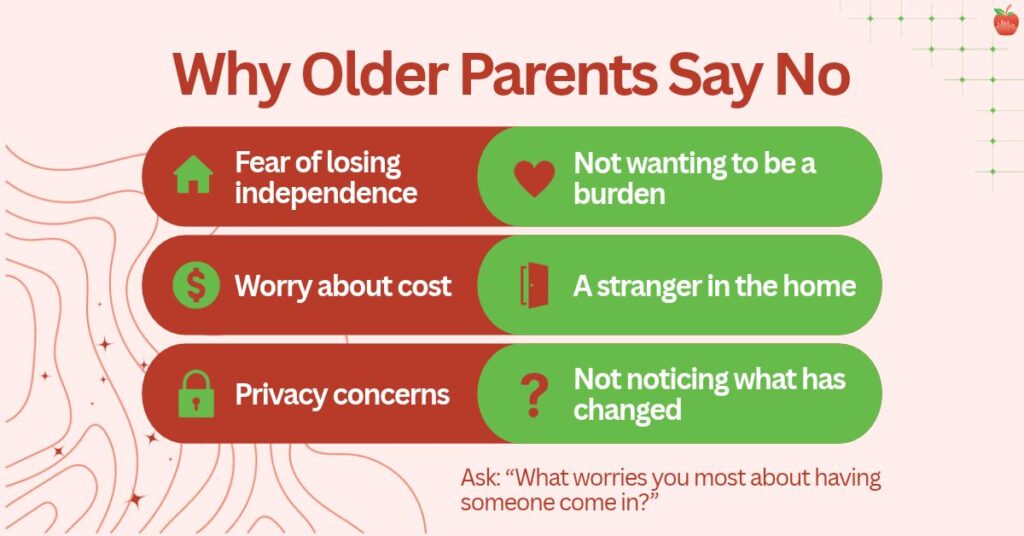
When an elderly parent refuses help, the real reasons are often unspoken. Common ones include:
- Fear of losing independence or being moved out of their home.
- Pride, or not wanting to feel like a burden.
- Worry about cost.
- Discomfort with a stranger in the home, especially for bathing or dressing.
- Privacy concerns about money, mail or health.
- Not noticing how much has changed, which can happen with memory problems.
Try asking an open question, such as “What worries you most about having someone come in?” The answer often points straight to the fix.
How Do You Start the Conversation?
Start the conversation at a calm time, in private, without other family members piling on. Lead with what your parent wants, like staying at home. Use “I” statements, such as “I worry when you climb the stairs alone.” Ask questions instead of giving orders, and pick one concern to discuss. Then let your parent think it over.
Timing matters. Avoid holidays, busy family dinners or moments right after a fall or argument. Bring up one concern at a time, and stop if the talk turns heated. You can return to it another day.
What to Say Instead
- Instead of “You can’t live alone anymore,” try “What would make living here easier for you?”
- Instead of “You need a caregiver,” try “Would you try having someone help with groceries and laundry for a few weeks?”
- Instead of “You’re not safe,” try “I’d feel better knowing someone is checking in when I can’t.”
- Instead of “We’ve decided,” try “Here are a few options. Which sounds best to you?”
Framing help as something that eases your worry can also work. An elderly parent who refuses help for their own sake may still accept it to take pressure off their children.
How Can You Make Help Easier to Accept?
Start small. A few hours a week of help with one task, like meals or laundry, feels less threatening than full-time care. Once trust builds, the hours can grow.
Give your parent real choices. Let them pick the day, the time and the tasks. If you use a home care agency, ask whether your parent can meet the aide first or request someone who speaks their language.
Try a set trial period, such as one month, and agree to review it together. A defined end date makes saying yes feel less permanent.
Sometimes a message lands better from someone outside the family. A doctor, a social worker or a trusted friend may get further than a son or daughter can.
Should the Whole Family Meet?
A family meeting can help everyone pull in the same direction. The Family Caregiver Alliance recommends including everyone who is or will be part of the care team, which may include friends, neighbors or a paid caregiver.1
Related Source: The Family Caregiver Alliance generally recommends including the parent in the meeting, since their wishes matter. If the topic is painful or memory is a concern, families can hold one meeting without the parent first, then a second meeting with them present.1
A few ground rules from the Family Caregiver Alliance help keep the meeting productive:1
- Give everyone a chance to speak, and acknowledge feelings.
- Use “I” statements and say what you need.
- Explore the problem before jumping to solutions.
- Set a clear start and end time.
- Write down agreements and share them afterward.
If the family is split or stuck, a neutral facilitator can help. Options include a social worker, a physician or a home health social worker.1
What If Your Parent Still Says No?
If your parent still says no and can make their own decisions, you generally need to respect that choice. Keep the conversation open, check in often and look for small ways to reduce risk, like grab bars or a medical alert device. Revisit the topic when something changes, such as a fall, an illness or a new diagnosis.
When an elderly parent refuses help, remember that a capable adult has the right to make choices you disagree with. That is hard to accept, but respecting it protects your relationship. Your parent is more likely to call you when they do need help.
While your elderly parent refuses help, build a quiet safety net. Keep a list of their medicines and doctors. Set up regular phone check-ins. Make sure a neighbor or building super has your number.
When Is It Time to Step In?
It is time to step in when your parent’s safety is at real risk. Warning signs include falls, missed medicines, spoiled food, unpaid utility bills, wandering or signs that someone is taking advantage of them. Call 911 for any emergency. For serious ongoing risk in New York City, you can contact Adult Protective Services by calling 311.
Sudden confusion, memory loss or a big change in behavior also needs a doctor’s attention. These changes can have many causes, and some are treatable.
In New York City, Adult Protective Services (APS) helps adults 18 and older who cannot protect themselves. A person must meet all three of these conditions:2
- They have a mental or physical impairment.
- Because of it, they cannot manage their needs or protect themselves from harm, neglect or exploitation without help.
- No one else is available who is willing and able to help them responsibly.
You can make a referral by calling 311, calling 718-557-1399 on weekdays or submitting a form at nyc.gov/apsrefer.2 Referrals are confidential, and APS accepts anonymous referrals.2 Most APS services are voluntary.2 For an emergency or life-threatening situation, call 911.2
Where Can New York Families Get Support?
NYC Aging’s Caregiver Program offers information, support groups, counseling and help with long-term care planning.3 Call Aging Connect at 212-AGING-NYC (212-244-6469) to find a program near your parent.3
How Does City Choice Home Care Help Hesitant Parents?
City Choice Home Care has been a licensed New York home care provider since 2005. Our home health aides and personal care aides help with bathing, dressing, meals, medication reminders and moving safely around the home. They also offer company and a friendly face.
If your elderly parent refuses help from strangers, the right match matters. We consider care needs, language, culture and personality when we match an aide. There are no long-term contracts, so your parent can try a few hours of help without feeling locked in.
Every caregiver is background-checked, bonded, insured and trained through a program approved by the New York State Department of Health. We hire only about 1 in 25 applicants. Our team serves families across Manhattan, Brooklyn, Queens, The Bronx, Staten Island and Westchester, with a 24/7 intake line. Contact us to talk through a gentle start.
Related Guides
- Home Care in New York: A Complete Guide
- Home Care Services
- Why City Choice
- Service Areas
- Pediatric Home Care in New York City
Sources
- Family Caregiver Alliance. Holding a family meeting. Accessed November 10, 2026. https://www.caregiver.org/print/56
- NYC Department of Social Services, Human Resources Administration. Testimony on Adult Protective Services referrals. April 16, 2025. Accessed November 10, 2026. https://www.nyc.gov/assets/hra/downloads/pdf/news/testimonies/2025/DSS-HRA-testimony-on-Adult-Protective-Services-Referrals-04-16-25.pdf
- NYC Aging. Caregiving. NYC Department for the Aging. Accessed November 10, 2026. https://www.nyc.gov/site/dfta/services/caregiving.page