OPWDD Self-Direction: A Plain-English Guide for New York Families
Support Broker. Fiscal Intermediary. Personal Resource Account. If you have heard these terms at a Life Plan meeting and walked out more confused than when you walked in, you are in good company. OPWDD Self-Direction gives families more say over their child’s supports, but the vocabulary can feel like a second language.
This guide translates it. It explains what Self-Direction is and the two types of authority you can choose. You will also learn who is on your team, what you can direct and how to decide whether it fits your family.
What Is OPWDD Self-Direction?
OPWDD Self-Direction is a way for people with developmental disabilities, and their families, to choose and manage their own supports. Instead of only using services as an agency arranges them, you can choose staff, set schedules and decide how your child gets support. It is available to people enrolled in OPWDD’s Home and Community Based Services Waiver.
OPWDD describes Self-Direction as a way to choose your own services so you can live the life you want.1 It offers more flexibility to pick supports, choose the people you work with and set a schedule that works for you.1
Self-Direction can shape many parts of a person’s life. These include how they spend their days, what they do in their free time, how they stay healthy and who they hire to help them.1
Who Can Self-Direct?
Self-Direction is open to people who are eligible for OPWDD services and enrolled in the Home and Community Based Services (HCBS) Waiver.1 OPWDD notes it may suit people who can make their own decisions, or who have someone to help them, and who want more responsibility and flexibility.1
For a child, parents and other trusted adults usually play a large part in those decisions. That is where the Circle of Support comes in.
What Is the Difference Between Employer Authority and Budget Authority?
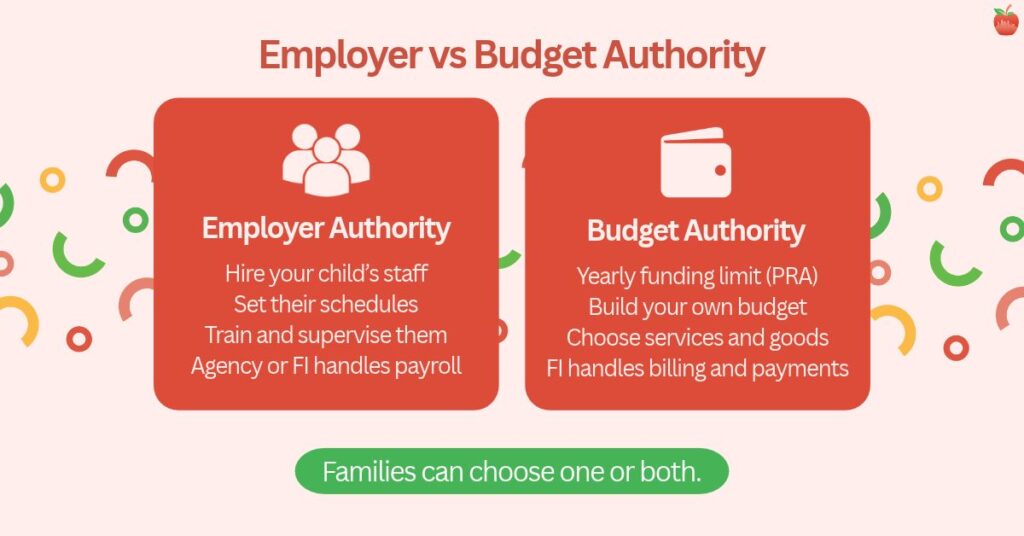
Employer authority means you hire, schedule, train and supervise the staff who support your child, while an agency or Fiscal Intermediary handles payroll. Budget authority means you work within a yearly funding amount and decide which services and goods to buy. Families can choose either one or both, depending on how much responsibility they want.
OPWDD calls these two levels of control “authorities.” A person may choose either one or both.2
Employer Authority
With employer authority, you hire, schedule and supervise the staff who work with your child.2 You decide what activities they support and how.2 Along the way, you can train staff on your child’s interests, give feedback and end their services if they are not a good fit.2
Under the agency-supported option, staff are agency employees, and you co-manage them.2 If you self-hire staff instead, you also gain budget authority and help set their pay.2
Budget Authority
With budget authority, you work within a funding limit called a Personal Resource Account, or PRA.2 You build a Self-Direction Budget, choose the goods and services you want and decide who provides them.2 A Fiscal Intermediary handles the billing and payments.2
Who Is on a Self-Direction Team?
A Self-Direction team usually includes your Circle of Support, your Care Manager, a Support Broker and a Fiscal Intermediary. Your Circle of Support helps make decisions. A Care Manager links everyone and keeps the Life Plan current. Meanwhile, a Support Broker builds and tracks the budget, and the Fiscal Intermediary handles billing, payroll and paperwork.
Here is what each role does, in plain terms:
- Circle of Support: a team you choose to help pick services and build a budget. It can include family, close friends, your Care Manager, a Support Broker and staff who know your child well.1
- Care Manager: connects the team, keeps the Life Plan up to date and reviews the Self-Direction Budget at least twice a year with you.5
- Support Broker: helps you build and manage the Self-Direction Budget and track spending each month.4
- Fiscal Intermediary (FI): handles billing and payment, accounting and compliance. For self-hired staff, the FI is the employer of record and follows labor laws on your behalf.3
Support Brokers can be paid or unpaid. Both must complete OPWDD training before they start.4
What Can Families Direct?
Self-Direction offers several staffing options. With the agency-supported option, families can self-direct community habilitation, supported employment and respite using employer authority.3 Families with budget authority can also self-hire staff or buy services directly from provider agencies.3
Budget authority can also cover certain goods and services through Individual Directed Goods and Services.2 Some supports exist only in Self-Direction. One example is a Paid Neighbor, someone paid a monthly stipend to be on call when the person needs help.6
Is Self-Direction Right for Your Family?
Self-Direction may be right for your family if you want more control over who supports your child and when, and you have time to help hire, schedule and supervise staff. It suits families comfortable with some paperwork and budget tracking. If that feels like too much, agency-run services remain an option, and you can switch back later.
Ask yourself these questions before deciding:
- Do we want to choose the specific people who work with our child?
- Do we have a few hours each month for hiring, scheduling and reviewing reports?
- Is there someone in our circle we trust to help with budget decisions?
- Would a Support Broker’s help make the budget side manageable?
- Are we comfortable being the backup if a staff member calls out?
OPWDD notes that you can change your plan at any time and return to a more traditional model of supports.1 Starting with employer authority only is one way to test the waters.
How Do Families Get Started?
If your child already receives OPWDD services, OPWDD outlines three basic steps:1
- Talk with your Care Manager, who can explain Self-Direction and walk you through the process.
- Attend a Self-Direction information session at your Developmental Disabilities Regional Office.
- Meet with your Circle of Support to choose services and build a budget.
OPWDD also offers checklists for participants and for the Circle of Support.1 They are a helpful way to keep track of who does what.
Is OPWDD Self-Direction Changing?
OPWDD hired the consulting firm Guidehouse in 2024 to review its Self-Direction model. The final report, announced in October 2025, offered eight recommendations to improve the program.7
Related Source: The Guidehouse assessment reports that OPWDD Self-Direction serves approximately 30,000 New Yorkers. One of its goals was to understand the needs of minors and help families make informed choices about their child’s services.8
Changes are already reaching families. In July 2026, OPWDD released a new Self-Direction Budget Template, required for all OPWDD Self-Direction budgets from July 14, 2026. The new template raised each participant’s Personal Resource Account.9
More policies may shift as OPWDD acts on the Guidehouse findings. Check with your Care Manager for the latest rules before making big decisions.
How Does Home Care Fit In?
OPWDD Self-Direction covers waiver services. Many families also need hands-on help with daily care at home, like bathing, dressing, toileting and meals. That is where home care comes in.
City Choice Home Care has been a licensed New York home care provider since 2005. Our pediatric aides help children with daily routines at home and follow the routines your family has already built. Every caregiver is background-checked, bonded, insured and trained through a program approved by the New York State Department of Health.
City Choice Home Care is also an OPWDD-approved provider. Families whose child already receives OPWDD services can add home care alongside them. There are no long-term contracts, and you are never locked in.
We serve families across Manhattan, Brooklyn, Queens, The Bronx, Staten Island and Westchester, with a 24/7 intake line. Contact us to talk about your child’s daily care needs.
Related Guides
- Pediatric Home Care in New York City
- Pediatric Care Services
- Home Care in New York: A Complete Guide
- Service Areas
- Why City Choice
Sources
- New York State Office for People With Developmental Disabilities. Self-Direction. Accessed November 10, 2026. https://opwdd.ny.gov/types-services/self-direction
- New York State Office for People With Developmental Disabilities. Self-Direction for providers. Accessed November 10, 2026. https://opwdd.ny.gov/providers/self-direction-providers
- New York State Office for People With Developmental Disabilities. Self-Direction guidance for providers. March 10, 2022. Accessed November 10, 2026. https://opwdd.ny.gov/system/files/documents/2022/03/sd_guidance-final_march2022.pdf
- New York State Office for People With Developmental Disabilities. Self-Direction Support Broker checklist. 2025. Accessed November 10, 2026. https://opwdd.ny.gov/system/files/documents/2025/12/support-broker-checklist_acc.pdf
- New York State Office for People With Developmental Disabilities. Self-Direction Care Manager checklist. 2025. Accessed November 10, 2026. https://ar.opwdd.ny.gov/system/files/documents/2025/12/care-manager-checklist_acc.pdf
- New York State Office for People With Developmental Disabilities. Supports that help you live more independently in the community. Accessed November 10, 2026. https://opwdd.ny.gov/types-services/supports-help-you-live-more-independently-community
- New York State Office for People With Developmental Disabilities. Report on OPWDD Self-Direction model now available. October 30, 2025. Accessed November 10, 2026. https://opwdd.ny.gov/news/report-opwdd-self-direction-model-now-available
- Guidehouse. Self-Direction assessment final report: New York State Office for People With Developmental Disabilities. June 17, 2025. Accessed November 10, 2026. https://opwdd.ny.gov/system/files/documents/2025/10/nys-opwdd-self-direction-assessment-2025.06.17_acc.pdf
- Independent Support Services. Updated SD budget template, temporary modification for CAS/CANS assessment and new broker agreement. 2026. Accessed November 17, 2026. https://www.issny.org/updated-sd-budget-template-temporary-modification-cas-cans-assessment-new-broker-agreement/