
How to Make a Visual Schedule for Autism That Works at Home

Your child melts down every time you say “time to go.” Bath time turns into a standoff. Bedtime drags on for an hour. A visual schedule for autism can ease all three. It shows your child what happens next, in pictures or words, so the day stops feeling like a string of surprises.
This guide covers how to build one at home and how to teach your child to use it. It also shows how to keep the schedule the same no matter who is helping that day. That last part matters in a busy New York City household. Parents, grandparents, sitters and home care aides often share the routine. A schedule only works when every adult follows it the same way.
What Is a Visual Schedule for Autism?
A visual schedule for autism is a set of pictures, objects or words that shows the order of activities in a day. Your child checks it to see what is happening now and what comes next. Finished steps come off the board. The schedule makes time and expectations visible, which can lower anxiety and build independence.
The TEACCH Autism Program at the University of North Carolina describes a visual schedule as a way of organizing time.2 It can include meals, chores, playtime, appointments and favorite activities. The format should match what your child understands today, not what you hope they will understand next year.
Why Do Visual Schedules Help Autistic Children?
Transitions are hard for many autistic children. Spoken words disappear the moment you say them. A picture stays put. Your child can look back at it as often as needed, without waiting for an adult to repeat the plan.
Visual schedules also reduce the number of verbal prompts a child needs. Research reviewed by the Association for Science in Autism Treatment found that a schedule can act as a prompt on its own.3 Over time, children can rely on the schedule instead of on the people around them.
Related Study: A review of 20 years of research in the Journal of Autism and Developmental Disorders found that visual activity schedules meet the bar for an evidence-based practice in autism. The strongest results came when adults paired the schedule with step-by-step teaching.4
The National Clearinghouse on Autism Evidence and Practice reached a similar conclusion. Its 2020 review lists visual supports, including schedules, as an evidence-based practice backed by more than 100 studies.1 That evidence covers every age group from toddlers to young adults.
Which Type of Visual Schedule Should You Use?
The best type of visual schedule depends on how your child understands symbols right now. Real objects suit children who are not yet using pictures. Photos work well for children who recognize familiar places and items. Picture symbols and written words fit children with stronger language skills. You can mix formats and move up as skills grow.
Pick a Format
- Objects: a cup for snack time, a sock for getting dressed, a toothbrush for bedtime.
- Photos: real pictures of your child’s bathroom, the school bus or their favorite chair.
- Picture symbols: simple drawn icons, often printed and laminated.
- Written words: a checklist for children who read.
The Association for Science in Autism Treatment also notes options like a small picture book, a sliding bar or a tablet app.3 Some families use a phone app on outings, since it fits in a pocket. Others prefer a board on the wall at home, because it never runs out of battery.
Pick a Length
Start short. A first-then board shows only two steps, such as “first shoes, then park.” Once your child follows that, add a third and fourth step. Later, you can build a half-day or full-day schedule.1 Children who feel overwhelmed by a long list often do better with a short one for each part of the day.
How Do You Make a Visual Schedule at Home?
To make a visual schedule at home, choose one routine that causes stress, such as getting ready for school. Break it into small steps. Pick a format your child understands, like photos or icons. Arrange the steps top to bottom or left to right. Post the schedule where the routine happens, and review it before you begin.
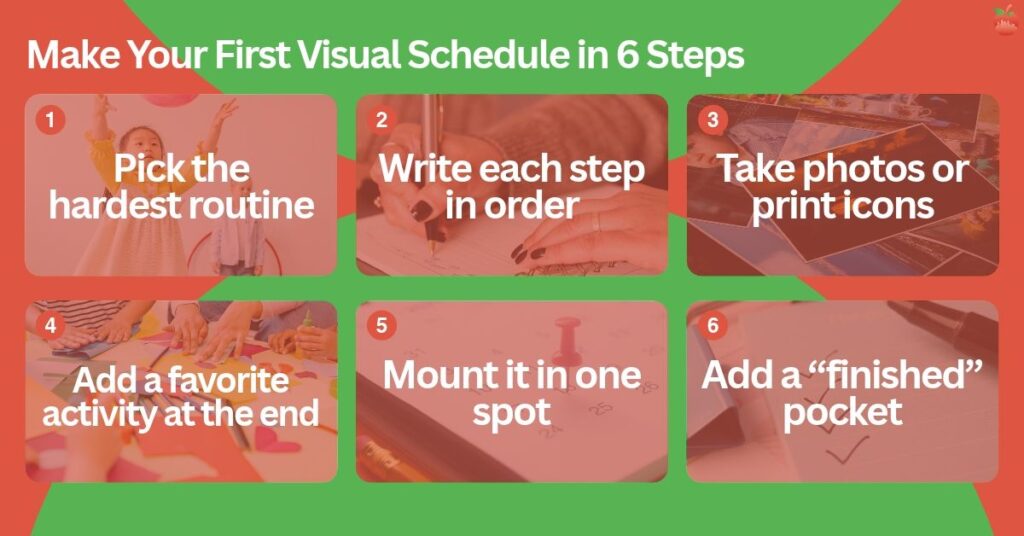
Here is a simple way to build your first one:
- Step 1: Pick the hardest routine of the day. Mornings and bedtime are common choices.
- Step 2: Write down each step as your child actually does it, in order.
- Step 3: Take photos or print icons for each step.
- Step 4: Add a favorite activity at the end, like a show or a snack. TEACCH recommends including preferred activities so your child knows when they are coming.2
- Step 5: Mount the schedule in one spot and keep it there. Fridge doors and bathroom walls work well.
- Step 6: Give your child a way to mark each step as done, such as a “finished” pocket.
Small apartments need a little creativity. A strip of Velcro on the back of the front door can hold a going-out schedule. For bath time, a shower caddy can hold a waterproof bath schedule. Keep each schedule close to where the routine happens, so your child does not have to cross the apartment to check it.
How Do You Teach Your Child to Use It?
A schedule does not teach itself. The AFIRM team at the University of North Carolina suggests a few clear steps.1 Stand behind your child so they look at the schedule, not at you. Hand them the picture for the next activity. Use short words, like “bath time.” Help them get to the activity and put the picture in its spot.
Repeat this every time the routine comes up. As your child starts moving through the steps alone, step back. Cut your prompts quickly, so your child learns to follow the pictures instead of your voice.1 Praise them when they check the schedule on their own.
How Do You Handle Changes to the Schedule?
To handle a change, show it on the schedule before it happens. Use a “change” card that says what is different, such as “Instead of the park, we will go to the library.” Point to the card, name the new activity, and swap the picture. Practice small, planned changes on calm days so surprise changes feel more familiar.
AFIRM offers a “Change Alert” template built on the same idea, with an “Instead of” line and a “We will” line.1 Life in the city brings plenty of changes. Elevators break. Buses run late. Rain cancels the playground. A change card turns each one into a small, expected step rather than a crisis.
How Can Every Caregiver Follow the Same Schedule?
Consistency is where many home schedules fall apart. A parent uses the board in the morning. Then a grandparent skips it at lunch. By bedtime, the sitter is improvising. Your child learns that the pictures only matter with certain people.
AFIRM stresses that all adults should share the same expectations, the same praise and the same follow-through.1 Write a short handoff sheet and tape it next to the schedule.
A Simple Caregiver Handoff Checklist
- Where each schedule lives and which routine it covers.
- The exact words you use for each step, like “potty” or “bathroom.”
- How your child marks a step as done.
- The reward at the end of each routine.
- How to use the change card.
- What helps your child calm down if a step goes wrong.
Share this sheet with anyone who cares for your child, including a home care aide. A good aide will follow your child’s established routines rather than inventing new ones.
What Does a Sample After-School Schedule Look Like?
Every child is different, so treat this as a starting point. Here is one after-school routine for a family in an apartment building:
- Take off shoes and put away backpack.
- Wash hands.
- Snack at the table.
- Quiet play or a sensory break.
- Homework or a learning game.
- Dinner.
- Bath.
- Pajamas and brush teeth.
- Story, then lights out.
Notice the snack and play come before homework. Placing a favorite activity next gives your child something to look forward to. Adjust the order to fit your family, and keep it the same each day once it works.
When Should You Change Your Approach?
Give a new schedule a few weeks of steady use before judging it. If your child still struggles, look at the details. The format may be too hard, or the schedule may be too long. Maybe the reward is not motivating enough. AFIRM suggests checking each of these before trying a different strategy.1
Talk with your child’s teacher or therapist, too. Ask how they use visual supports at school or in therapy, so home and school match.1 If your child shows sudden changes in behavior, sleep or eating, speak with their doctor.
How Does City Choice Home Care Services Support Families?
City Choice Home Care Services has been a licensed New York home care provider since 2005. Our pediatric aides help children with bathing, dressing, toileting, meals and other daily routines at home. They follow the routines your family has already built, including your child’s visual schedule.
Every caregiver is background-checked, bonded, insured and trained through a program approved by the New York State Department of Health. We hire only about 1 in 25 applicants. When we match an aide with your family, we consider your child’s needs, language, culture and household logistics.
City Choice Home Care Services is also an OPWDD-approved provider. Families whose child already receives OPWDD services can add home care alongside them. There are no long-term contracts, and you are never locked in.
We serve families across Manhattan, Brooklyn, Queens, The Bronx, Staten Island and Westchester. Our intake line is open 24/7. Contact us to talk through what your child needs.
Related Guides
- Pediatric Home Care in New York City
- Home Care in New York: A Complete Guide
- Pediatric Care Services
- Home Care Services
- Service Areas
Sources
- Sam A, AFIRM Team. Visual supports. Autism Focused Intervention Resources and Modules, Frank Porter Graham Child Development Institute, University of North Carolina at Chapel Hill. Updated 2024. Accessed November 10, 2026. https://afirm.fpg.unc.edu/wp-content/uploads/Visual-Supports-Brief-Packet.pdf
- TEACCH Autism Program. TEACCH Tip #1: Visual schedule. University of North Carolina School of Medicine. Accessed November 10, 2026. https://teacch.com/resources/teacch-tips/english/1-visual-schedule/
- Tereshko L. Visual activity schedules. Science in Autism Treatment. 2023;20(6). Association for Science in Autism Treatment. Accessed November 10, 2026. https://www.asatonline.org/for-parents/activity-schedules/
- Knight V, Sartini E, Spriggs AD. Evaluating visual activity schedules as evidence-based practice for individuals with autism spectrum disorders. J Autism Dev Disord. 2015;45(1):157-178. doi:10.1007/s10803-014-2201-z